
Roy and I walked from our house to our hangar, climbed in our RV-7A, and taxied out to the runway. “Ready?” Roy asked me.
I did my final check. Oxygen tubes in. Canopy closed. Flight plan entered. Phone, glasses, hat inside so nothing on the wing.
“Ready,” I replied.
We zoomed down the runway and lifted off, out of the Noilichucky River valley, up over the west side of the mountains, over dense, green river valleys, then down the east side, where the mountains fall away to flat land. We flew in silence, listening to the thrum of the engine and the voices of other pilots and air traffic control on the radio. We flew over green marshes, where rivers blend into the ocean. The air turned hazy. I could smell salt air.
“First Flight traffic, Silver RV N174RT, turning final, First Flight,” Roy said, announcing our arrival over the radio.
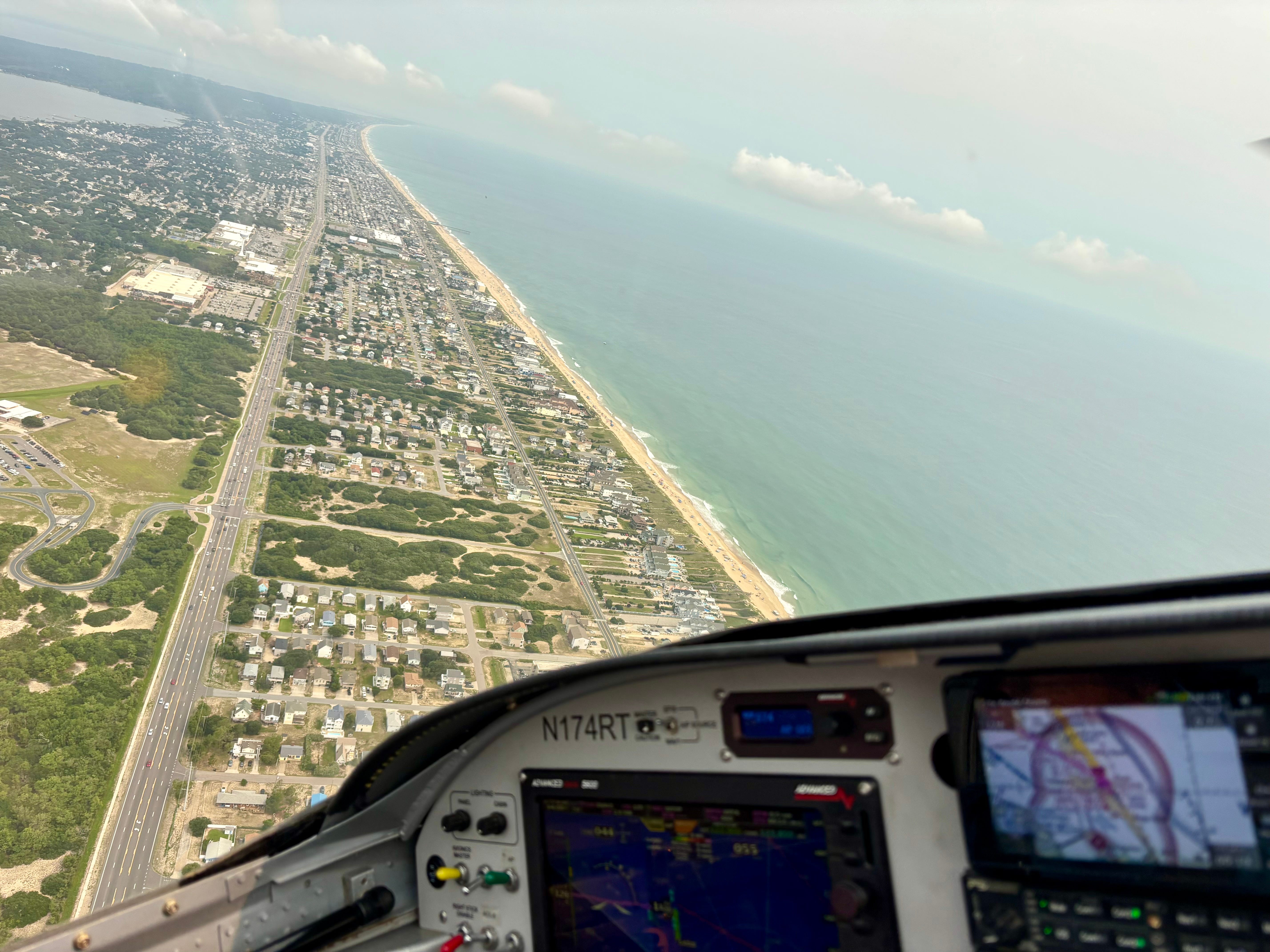
Roy tipped the wing as we descended. I looked down at lines of white foam rolling one after another onto white sand beaches. The inland side turned from brown sand to row after row of white hotels. We descended over a mini-golf course the size of a football field with a three-story-tall Teradactyl standing in a water feature. That thing should be called out on the chart as a hazard, I thought.
We descended onto a runway surrounded by a forest of yellow pine, deciduous trees and scrub. A tailwind off the beach disappeared below the treetops, and our plane did a little wobble dance. “Whooow,” I said, and grabbed my harness straps.
”First Flight, Silver RV 174RT, clear Two-One.” Roy said to the radio. He popped the canopy to let in air as we taxied to parking. The sky was washed gray-blue, too warm and humid, and we both began to sweat.
A National Park Ranger walked out to greet us. “Welcome, folks. Is this your first time at First Flight?”
Roy and I both nodded, “Yes.”
“Would you take our picture?” Roy asked.
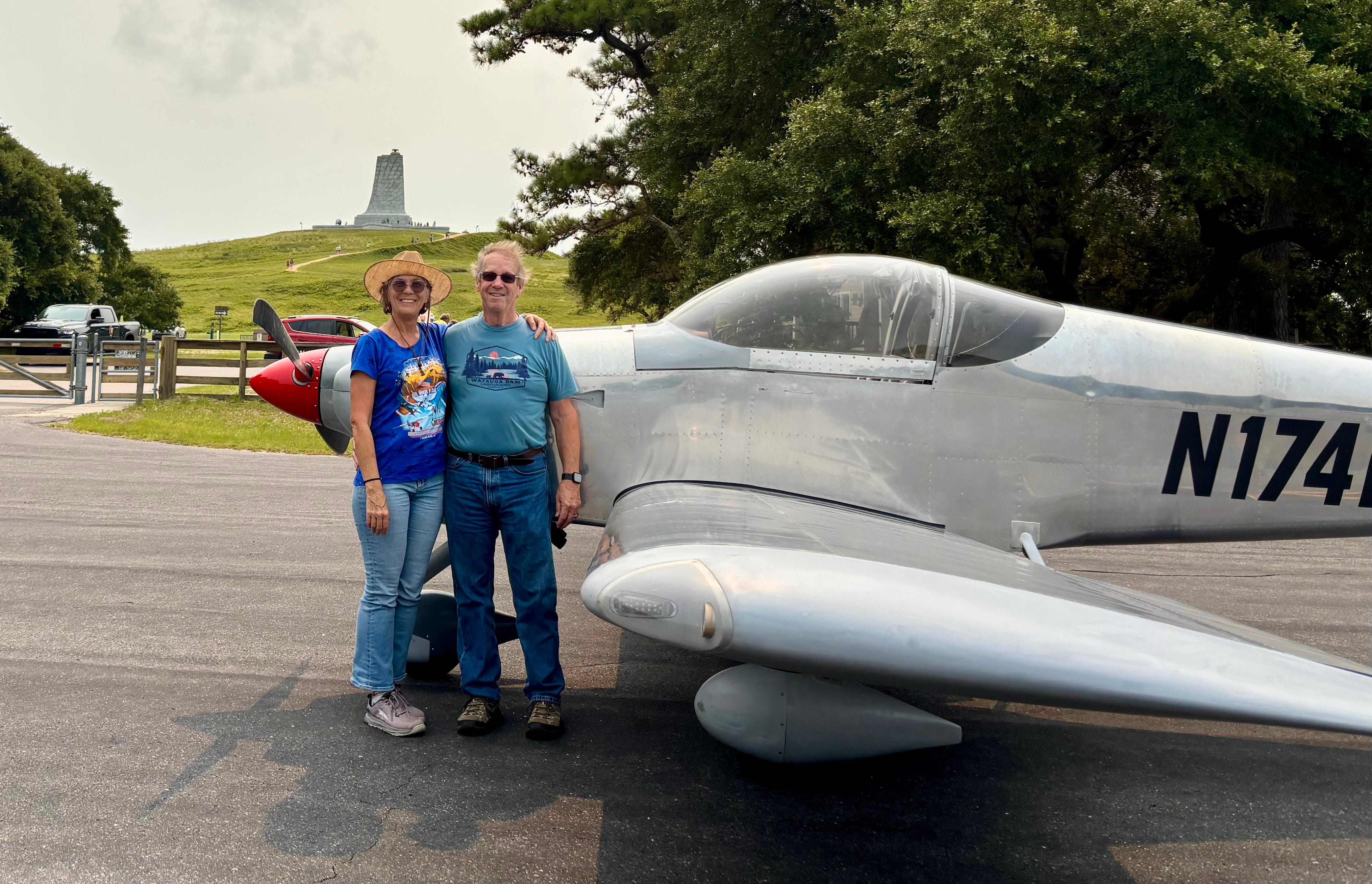
First stop: the national park office just outside the gate to the plane parking area, to find restrooms so we could change out of long pants for flying and into shorts for the heat and humidity on the ground. A sign outside the office read, Go see a recreation of the First Flight. “I guess we start here,” I pointed down the path.


Roy pointed to the concrete tower on top of a large, grass-covered sand dune. “I want to start there,” he said.
“Okay, then,” I replied. It looked like a hot, sweaty climb, but it was his birthday, and we were there for the experience. I took his hand, and we marched up a winding concrete path.
We were huffing-puffing and sweating by the time we reached the top. The memorial was beautiful and worth the hike, once I caught my breath. I walked around and admired the Pyramid-like layers swooping up that gave the illusion of a wing in flight. This is the giant sand dune that the Orville brothers and their team of helpers trudged up thousands of times to launch one prototype after another, finally arriving at The One that actually went some distance before crashing.
“The real work here was the courage to strap themselves to a wing and jump off this hill,” I said to Roy.
He nodded. “That and the engine.” He replied.
I reminded myself that my husband built our plane from sheets of aluminum, that our plane had its own first flight, and my husband was the pilot. That, and the engine.


“I understand the original crankcase is in the museum,” he said. “I’d like to see that.”
We held hands again, and we walked back down the hill, down a long, concrete path, through a hot, asphalt parking lot, down another concrete path, and into the air-conditioned bliss of the First Flight National Park visitors center. There were a million visitors inside, all traversing a loop of the pictorial history of the Wright brothers, all a big pressure wave, a traffic jam, moving at a snail’s pace. I looked up at the signs directing visitors to either the Wright Brothers history, the Gift Shop, or the Replica Aircraft.
“I’m not going in there,” I pointed toward the crowd. “Let’s go see the replica.”
“That’s probably where the crankcase is anyway,” Roy replied.
The replica is a work of art, set in the middle of a circular room with windows around half the building that looked out onto the actual flight path, with stone markers showing the distance flown by the first successful flight. The inner walls featured a display of highlights of the technology that enabled the aircraft to become airborne and stay there for some hundred or two hundred feet. We walked around the display and stopped in front of a glass case holding a large shard of an original propeller.
”Here is the real advancement.” I said. “A wing that spins fast enough to pull larger wings through the air at a speed they can obtain lift.”
“The engine to drive it,” Roy replied.
“And an engine to drive it,” I echoed. We continued around the display, until there, in front of us, was what remained of the original engine, with a plastic mock-up of the missing parts.
“Amazingly, they were able to preserve this,” Roy said.
We stood side-by-side and admired the miracle of innovation - that set our world on a path where people can have a house next to a runway, walk from the house to the hangar, climb into the plane they built, and fly in chairs in the sky, over the mountains, across the flat-lands, to the ocean, over rows and rows of hotels lining the beach and over a big plastic dinosaur, to land next to the giant sand dune where it all started.
“It really started with DaVinci,” I said.
Roy pursed his lips at me. “It was the engine,” he replied.
“Okay,” I acquiesce. “The engine helped. You could say it was the bicycles.”
Roy laughed. “Let’s go outside and see where the flights actually happened.”
We held hands again and headed back out to the heat.
Trip Logistics:
Airplane parking is available at First Flight, KFFA, for a maximum of 24 hours. The park has many visitors. There is no secure parking (gated access) at KFFA. On a friend’s recommendation, after visiting the National Monument, we flew the 6nm hop to Manteo, KMQI. Manteo is a large airport, with a nice FBO and has rental cars and services. The Airport Manager drove our rental out to the plane. At his suggestion, we went to Olive - a waterfront Greek restaurant. The food was wonderful, and for dessert we had a huge piece of baklava, while looking at sailboats in the marina below.
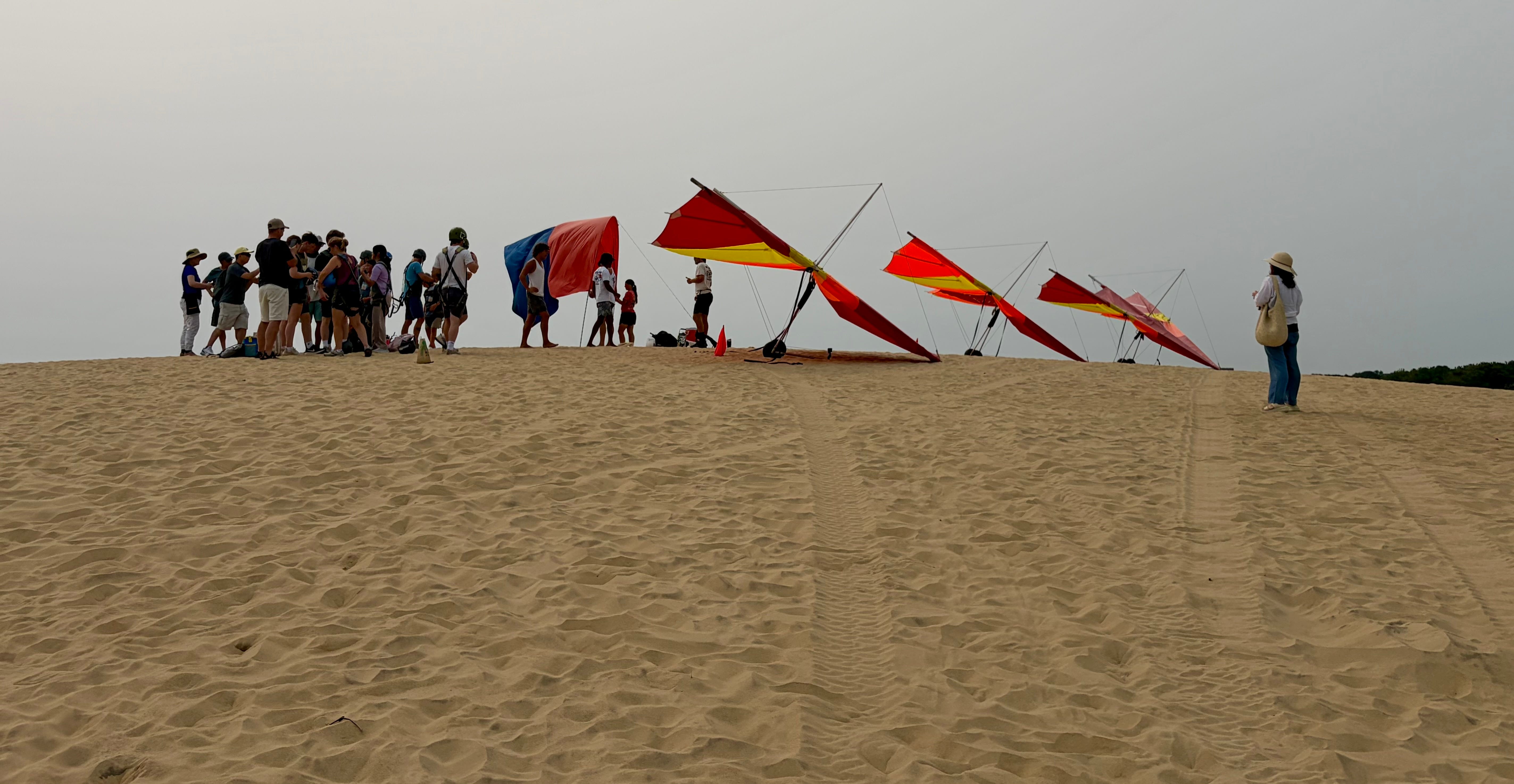
We found overnight accommodations in an Airbnb, just a short drive across a bridge, back in Kill Devil Hills, near First Flight. First Flight and the surrounding community of Kill Devil Hills are adjacent to the resort community of Nags Head, with lots of great restaurants, coffee shops, and shopping. We recommend visiting Jockey’s Ridge State Park. If you time it right, you might get to watch a hang-gliding lesson, and get a feel for what First Flight felt like before all the grass was planted to keep the dunes from shifting. We also visited Pea Island National Wildlife Refuge. There, we found a few other people and a beautiful long stretch of waves rolling up on the sand. This was a great survey trip, and encouraged us to explore the Outer Banks again in the future!